The Ticket Stub Is Not a Film Review
A cinema ticket stub can recover who came, where you went and what followed. Learn how to interpret its clues and preserve fragile paper thoughtfully.
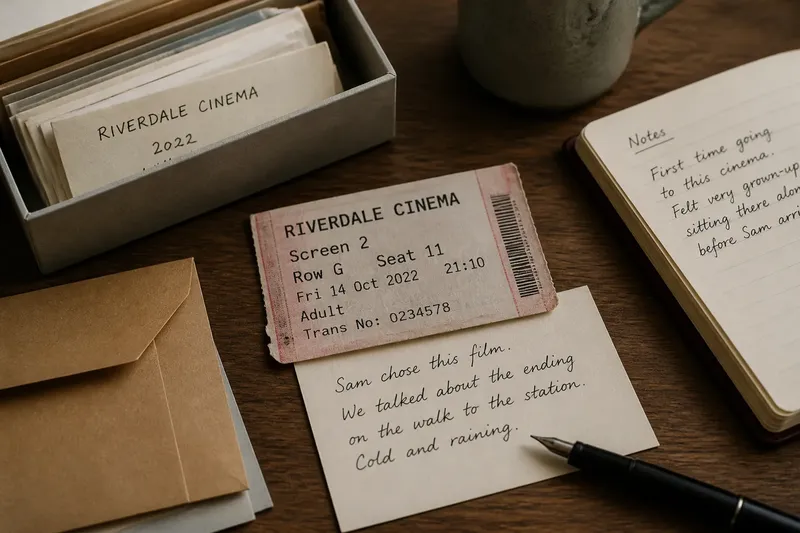
The common mistake with a saved cinema ticket is to treat it as a verdict: a good film earns a place, a poor one does not. That can discard the ticket that matters most. A cinema ticket stub is often more useful as a trace of an outing—its venue, company and circumstances—than as a record of whether the film succeeded.
What can a cinema ticket stub remember?
A ticket can hold clues about two different things: the film on screen and the occasion of seeing it. The title belongs to the first; the cinema name, date or seat may help recover the second. Neither has to stand in for the other.
You might remember a film as uneven and still value its ticket because it marks your first solo visit to a cinema. You might love a film and keep no paper from the evening. The stub records attendance, not approval.
When deciding whether to keep one, start with what you recall about the outing. A particular companion, an unusual journey home or a conversation afterwards may matter more than your opinion of the film.
Which printed details help recover the occasion?
A ticket may show the cinema, screen, seat, date, time, title or booking reference. These details are prompts rather than a complete account: a venue name might bring back a neighbourhood, while a late screening time may remind you of the trip home.
Some stubs carry little information, and thermal printing can become difficult to read. If a detail is still visible, record it separately from your recollection. For instance, “Screen 2” is printed information; “we talked about the ending on the walk back” is personal context.
Writing on a separate slip avoids pressing a pen into paper that may be fragile. Keep the note concise and specific enough to make sense when the evening is no longer fresh in your mind.
How does company change the memory?
A shared screening may be remembered through small reactions: a whispered comment, a companion’s silence during the credits or a disagreement about a scene. The ticket cannot record those moments, but its title and venue can help you find them in memory.
Imagine you find a ticket whose title and cinema you recognise but whose date is hard to read. You remember that Sam chose the film and that you discussed its ending on the walk to the station. You write those details on a separate slip and place it with the ticket. The result is a record that connects the outing to a conversation without pretending to be a review.
If another person’s name feels too private to keep, a phrase such as “with my sister” can preserve the connection without adding more detail.
What can’t a ticket tell you?
A stub cannot reliably say how crowded the cinema was, what you thought of the sound or how you felt about the story. A printed seat number does not describe your response. Treating the object as evidence for more than it records can make a later memory seem more certain than it is.
If you want to preserve a view of the film, write it separately: perhaps a scene you admired, a question it left you with or a reason you would watch it again. That keeps your changing opinion distinct from the simpler fact that you attended.
A film may mean something different to you later, while the companion or place remains important. The ticket can mark the occasion without fixing your judgement.
How should you handle and store a ticket?
Paper condition varies, so avoid assuming that one storage product suits every stub. Keep tickets away from damp and direct sunlight, handle them gently, and do not apply tape, glue or lamination if you want to preserve the original; these can alter the paper or make later handling harder. If the ticket is brittle, stained or otherwise delicate, ask a paper conservator or an archive for advice before placing it in a sleeve.
For an intact ticket, a clean paper envelope can keep it with a separate note without attaching anything to the stub. If you consider a plastic sleeve, choose one identified by its maker as suitable for paper storage, and check that it is clean and does not press or bend the ticket. A photograph can preserve a readable copy when the original is fragile, though it cannot preserve the paper itself.
- Check for dampness or a musty smell. If the ticket is damp, do not seal it in an envelope; let it dry in a safe, ventilated place, and seek conservation advice if damage is visible. If it is dry, use a clean paper envelope for storage.
- Check whether the paper is brittle or flaking. If it is, avoid repeated handling and do not insert it into a tight sleeve; photograph it carefully and ask a paper conservator about the original. If it is intact, handle it by the edges.
- Check whether the print is faint or fading. If details are still legible, photograph the ticket and note what you can read; if not, record only what you genuinely remember rather than filling in missing text.
- Check whether the proposed sleeve is identified as suitable for paper. If its material or suitability is unclear, use a clean paper envelope instead; if the maker identifies it for paper storage and the ticket fits without bending, it may be an option.
- Check whether the storage spot receives direct sunlight or may become damp. If it does, choose a drier, shaded place; if it does not, keep the envelope there and avoid stacking heavy items on the ticket.
- Check whether a note would require writing on the ticket. If it would, write on a separate slip; if the ticket already has enough context, keep it without adding a note.
For a few tickets, an arrangement by cinema or companion may help you locate the occasion. The point is to make the record findable, not to rank the films or build a collection around every visit.
What do people ask about keeping cinema tickets?
Should I keep a ticket from a film I disliked?
Keep it if the outing itself matters to you, perhaps because of the company or the place. The stub need not endorse the film to serve as a personal record.
What if the ticket has faded?
Photograph any remaining legible details and write down what you remember without guessing at missing print. If you cannot recall a detail, leave it unknown.
Can a ticket count as a film review?
Usually not: a ticket records admission details, not a considered response. Keep any opinion in a separate note so it remains distinct from the fact of attendance.
How should I organise a few stubs?
Choose a simple grouping that helps you find an occasion, such as by cinema or companion. If no grouping adds useful context, keep them together in one envelope rather than creating a ranking.
How can a cinema ticket stub remain an honest record?
The stub’s value lies in what it can prompt, not in what it can prove. Its title and venue may start a search through memory; a separate note can preserve a detail the printed paper never captured. When you keep one, distinguish what the ticket says from what you remember, and leave uncertain details uncertain. That small distinction lets the object mark an evening without turning it into a score for the film.